Six years, then a dead screen
ET Portfolio shut down without warning. I rebuilt the one thing I actually missed, the single glance, and it asks for nobody's PAN.
For about six years, the first thing I did with my investments was look at one number. Not trade, not rebalance, just look. ET Portfolio gave me a single screen with my net worth on it, and I watched that number move through a covid crash that genuinely scared me, a couple of wars, and the quiet monthly drip of SIPs that kept buying while I wasn't paying attention. Over those years the portfolio compounded to roughly 117%, an XIRR of 18.2%, though I mostly experienced it as a figure crossing round numbers I had half been waiting for. That small hit of "oh, nice" was the whole reward.
Then one morning the screen was dead. My first thought was the boring one: my network, or ET having a bad day. I refreshed it for a while, as if that would help. The official word came later. The portfolio tracker was being discontinued, effective more or less immediately, with no migration and no warning worth the name.
What hit me wasn't that my data was gone. It wasn't, really. Every fund I held still existed in the AMC's records, in my folios, in MFCentral, scattered across a dozen logins. What died was the collation. The one place that pulled all of it into a view I could read in three seconds. I kept thinking about people who had patiently entered ten or twenty funds into that app. The funds were safe. The picture they had assembled was the part that evaporated.
So I went looking for a replacement and ran into the same wall every time. To show funds across more than one PAN in a single view, the apps wanted the PAN. And the folio numbers. And in a few cases a broker login, or a CAS statement to parse. I understand why: that data gives a more accurate, more complete picture than anything I could assemble by hand. But I didn't want to hand my PAN and my folio numbers to an app I had known for four minutes. There is an old line that kept surfacing while I read their permission screens: when the product is free, you are the product. I couldn't tell, in most cases, whether it applied. The uncertainty was enough.
I have been a software engineer for a long time, and somewhere in the annoyance a quieter thought showed up: I could just build this. It looked like a weekend project. It was closer to three. The part that made it feel worth doing was a small technical realization. To mark a portfolio to market every day, the only thing that genuinely has to come in from outside is the day's NAV. And NAV isn't private. AMFI publishes it for every scheme in the country, for free, every evening. No PAN, no login, no statement to parse. If I was willing to tell the app what I had bought, it could tell me what it was worth, using nothing but a public number.
That is the whole design. You declare your SIPs and lumpsum buys once. The app accrues units on each installment date at that date's NAV, marks everything to today's live NAV, and shows you net worth, returns, and XIRR. It groups holdings under labels, one per person, so a household can see each member's portfolio and a combined total, all without a single PAN crossing the wire. Building it end to end was the fun I had been missing: the UI, the API, the AMFI integration, the schema, the tests, the deploy, the monitoring. And now, apparently, the promoting.
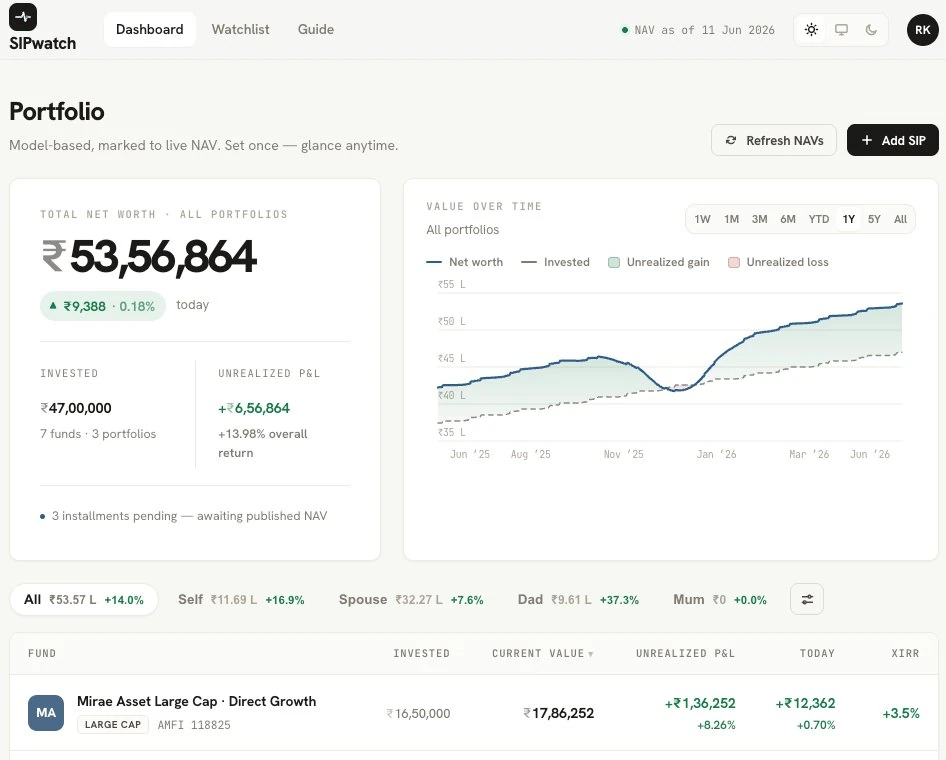
I want to be straight about what this isn't. Because the app models your SIPs instead of syncing your actual transactions, it isn't a mirror of your real account. The broker-linked and CAS-parsing tools win on accuracy. If you stopped a SIP six months ago, they know. Mine doesn't, unless I tell it. For a while I filed that under limitation.
Then I noticed what the limitation actually does. Suppose you stop a SIP and come back a year later. A synced app shows you reality: you stopped, so the contributions stopped. Mine keeps going, because you told it the plan and never told it you quit. So it shows you the portfolio you would have had if you had kept going. The number you walked away from. I am not sure there is a gentler, or a sharper, way to be told to start again.
I called it SIPwatch. If ET leaving you on a blank screen is why you are reading this, there is a page that picks up exactly there: sipwatch.in/et-portfolio-alternative.